Is HoFH hiding in your practice?

Decode HoFH
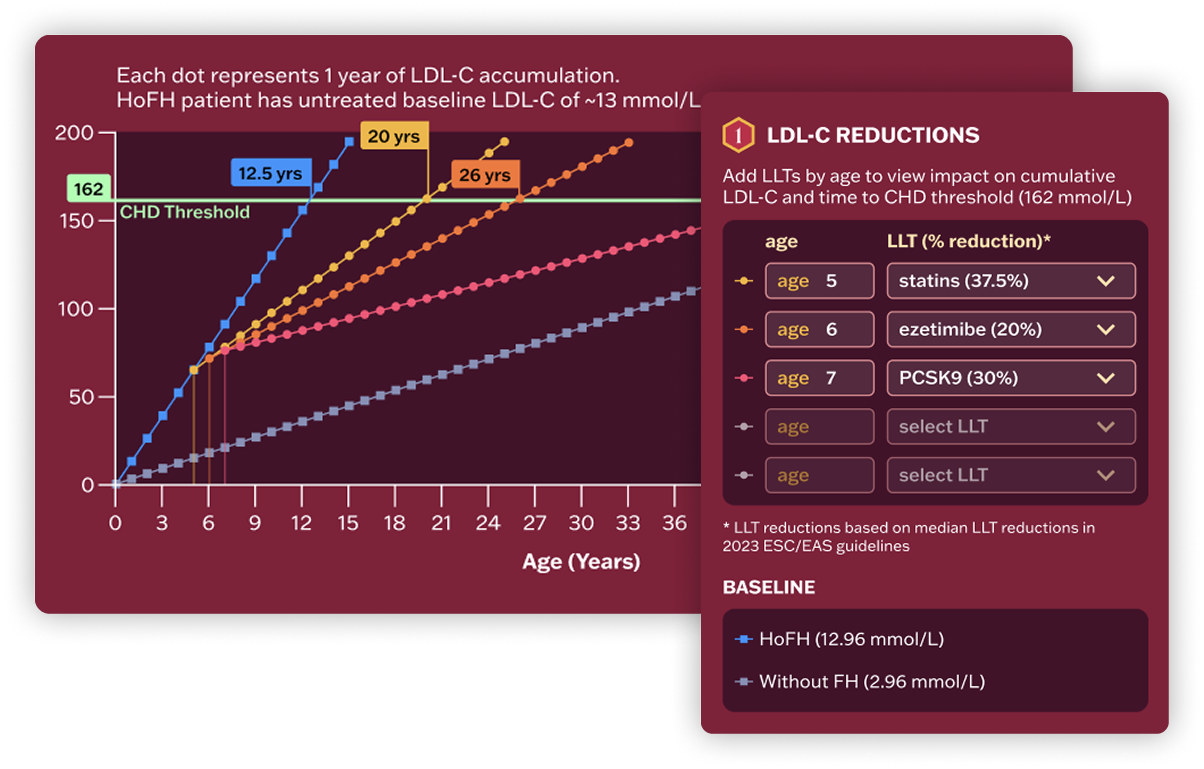
Reveal the potential impacts of LDL-C reductions on cumulative LDL-C. Consisting of three models, this tool leverages LLT reduction ranges from the ESC/EAS guidelines.
Try the LDL-C Modelling ToolFor educational purposes only:
this tool is not intended for diagnosis or treatment of real patients.

HoFH: A Caregiver
Story
Watch this video featuring Karen, a
caregiver to two sons with HoFH, sharing
her journey from early symptoms to
diagnosis and ongoing care.
Homozygous familial hypercholesterolemia (HoFH) is an ultra rare, inherited genetic disorder of lipid metabolism1,2
HoFH is characterized by:1-4
- Markedly elevated plasma levels of LDL-C (untreated LDL-C >10 mmol/L)3
- Premature atherosclerotic cardiovascular disease and cardiovascular morbidity and mortality
-
Cholesterol buildup:
- around the joints and on the tendons (xanthomas)
- in the eyes (corneal arcus) and around the eyelids (xanthelasmas)
The current estimated prevalence of HoFH is 1 in 300,000.4
Prevalence is higher in these groups:
- 1 in 275,000 French Canadians5
- 1 in 30,000 Afrikaners in South Africa6
- 1 in 100,000 Christian Lebanese7
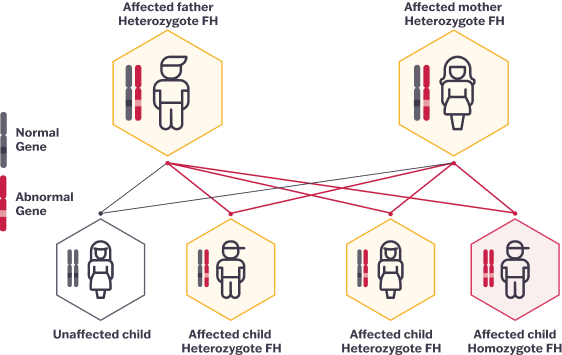
HoFH is an inherited lipid disorder
HoFH occurs when two pathogenic variants bearing the familial hypercholesterolemia (FH)-causing genes are inherited, one from each parent.1
HoFH differs from HeFH
| Homozygous FH (HoFH)3 | Heterozygous FH (HeFH)3 |
|---|---|
| Pathogenic variants inherited from both parents | Pathogenic variant inherited from one parent |
| Occurs in 1 in 300,000 persons | Occurs in 1 in 250 persons |
| LDL-C >10 mmol/L (untreated) |
LDL-C cholesterol ≥4.1 mmol/L in children LDL-C cholesterol ≥4.9 mmol/L in adults |
| Likely physical symptoms, such as cholesterol deposits in the eye, tendons, knees, elbows and/ or between fingers and toes; these deposits are not always present | May have physical symptoms, such as cholesterol deposits in the eye, tendons, knees, elbows and/or between fingers and toes |
| Treatment at time of diagnosis, no matter the age, with a specialist | Treatment as early as age 10 |
Adapted from McGowan and Cuchel et al.
Look for HoFH in your practice
Physical signs and risk factors associated with HoFH:1,3,8
- Untreated LDL-C >10 mmol/L – lower levels should not be discounted if other factors are present
- Cutaneous or tuberous xanthomas – highly suggestive of HoFH in children
- Corneal arcus – highly suggestive of HoFH
- Evidence of CVD – in young children early signs and symptoms are linked to aortic stenosis and regurgitation
- Family history of premature CVD
- Family history of HeFH
References
1. Cuchel M et al. Eur Heart J. 2023;00:1–15; 2. Raal FJ et al. Atherosclerosis. 2018;277:483–492; 3. McGowan MP et al. J Am Heart Assoc. 2019;8:e013225; 4.Tromp TR et al. The Lancet. 2022;399:719-728; 5. Moorjani S et al. Arteriosclerosis. 1989;9:211-6; 6. Seftel HC et al. Br Med J. 1980;281:633-6; 7. Slack J. Atheroscler Rev, 1979;5:35–66; 8. France M et al. Atherosclerosis. 2016;255:128–139;
![w-[17.125rem] h-auto](https://www.hofhdisease.ca/wp-content/themes/hofh/graphics/logos/gate/hofh.png)